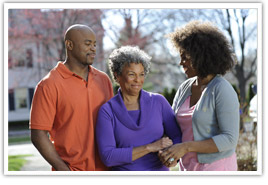
Most older persons with long-term care needs—65%—rely exclusively on family and friends to provide assistance.1 Another 30% will supplement family care with assistance from paid providers.2 Care provided by family and friends can determine whether older persons can remain at home. In fact, 50% of the elderly who have a long-term care need but no family available to care for them are in nursing homes, while only 7% who have a family caregiver are in institutional settings.3
Within our complex system of long-term care, women’s caregiving is essential in providing a backbone of support. In fact, the value of the informal care that women provide ranges from $148 billion to $188 billion annually.4 Women provide the majority of informal care to spouses, parents, parents-in-law, friends and neighbors, and they play many roles while caregiving—hands-on health provider, care manager, friend, companion, surrogate decision-maker and advocate.5
Many studies have looked at the role of women and family caregiving. Although not all have addressed gender issues and caregiving specifically, the results are still generalizable to women because they are the majority of informal care providers in this country. Consider:
An estimated 66% of caregivers are female. [Updated February 2015] 6, 7
The average caregiver is a 49 year old woman, caring for her 60 year old mother who does not live with her. She is married and employed. [Updated Februrary 2015] 8
Although men also provide assistance, female caregivers may spend as much as 50% more time providing care than male caregivers.9
Women’s Long-Term Care Needs
Women are the major providers of long-term care in this country, but they also have long-term care needs of their own. Women live longer than men, tend to outlive their spouses, and have less access to retirement savings such as pensions. In 2010, almost eight percent of all women were age 65 or older
10 [Updated February 2015]. A common scenario is an older woman who cares for her husband and who discovers that there are few resources—financial or otherwise—to meet her own needs for assistance. For example:
Women who were 65 in the year 2014 can expect to live another 24 years to age 86.11 [Updated February 2015]
In 2005, almost half (48%) of women age 75+ were living alone; compared to less than one quarter (22%) of men.12 [Updated February 2015]
In 2005, one in nine older women aged 75+ and one in five aged 85 or older, needed assistance with daily activities.13 [Updated February 2015]
Women, Work and Caregiving
The number of working women age 55 and older is projected to increase by 52% between 2000 and 2010, from 6.4 million to 10.1 million.
14As workforce participation increases, caregiving could pose even greater financial challenges for many women workers, due mostly to lost wages from reduced work hours, time out of the workforce, family leave or early retirement.
This time out of the workforce for caregiving may compound the impact of earlier leave taken to care for a child. Further, caregiving is expensive in and of itself. Whether it’s paying for prescription medications, installing a ramp for a wheelchair-bound care recipient, or purchasing consumable supplies, caregiving has a significant economic impact on a family. Women who are family caregivers are 2.5 times more likely to than non-caregivers to live in poverty and five times more liekly to recieve Supplemental Security Income (SSI).
15 [Updated February 2015]. Furthermore, a 2011 study by MetLife found that 23% of non-working and 20%of working female caregivers are providing financial assistance to parents that they are caring for.
16[Updated February 2015]
While the costs of providing care are high, the demands on caregivers’ time are also substantial. Estimates indicate that some 20 percent of all female workers in the United States are family caregivers.
17 [Updated February 2015]. But women don’t abandon their caregiving responsibilities because of employment. Instead, they cope—to the best of their abilities—with the combined pressures of caring for a loved one, their need for income, reliance on often inadequate public programs and fewer employment-related benefits.
18 Unmarried women caregivers may have even fewer options for balancing work and caregiving.
19
One national study on women and caregiving highlighted the conflicting demands of work and eldercare. The study found that:
20
- 33% of working women decreased work hours
29% passed up a job promotion, training or assignment
22% took a leave of absence
20% switched from full-time to part-time employment
16% quit their jobs
13% retired early
Other research paints a similar picture. For example:
Caregiving places a further strain on the precarious nature of many women’s retirement income, particularly since time out of the workforce does not only have short-term financial consequences. For most women, fewer contributions to pensions, Social Security and other retirement savings vehicles are the result of reduced hours on the job or fewer years in the workforce. Women caregivers are:25
Significantly less likely to receive a pension and, when they do, the pension is about half as much as those that men receive.
Likely to spend an average of 12 years out of the workforce raising children and caring for an older relative or friend.26
Complicating the picture, researchers have found that women who reduced their work hours while caregiving did not increase work hours once caregiving had stopped.27 Additionally, caregivers who return to full-time employment after caregiving are more likely to: 28
Caregiving also has a substantial impact on business. Absenteeism, replacing employees who quit in order to provide care and other caregiving-related activities can have serious financial consequences to employers. For instance:29
The cost to businesses to replace women caregivers who quit their jobs because of their caregiving responsibilities has been estimated at $3.3 billion.
Absenteeism among women caregivers due to caregiving responsibilities costs businesses almost $270 million.
The cost to businesses because of partial absenteeism (e. g., extended lunch breaks, leaving work early or arriving late) due to women’s caregiving has been estimated at $327 million. Caregiving-related workday interruptions add another $3.8 billion to the burden borne by businesses.
Health Consequences of Women’s Caregiving
The toll that caregiving takes is not just financial. Higher levels of depression, anxiety, and other mental health challenges are common among women who care for an older relative or friend. Studies find that men respond to caregiving responsibilities in a fundamentally different way. Women tend to stay home to provide time-consuming care to one or more ill or disabled friends or family members, while men respond to loved one’s needs for support by delaying retirement, in part to shoulder the financial burden associated with long-term care.
30The impact of the women’s intensive caregiving can be substantial.
One four-year study found that middle-aged and older women who provided care for an ill or disabled spouse were almost
six times as likely to suffer depressive or anxious symptoms as were those who had no caregiving responsibilities.
31 It’s not only care for a spouse that can affect mental health, however. The same study found that women who cared for ill parents were twice as likely to suffer from depressive or anxious symptoms as noncaregivers.
32
One in five female caregivers age 18 to 39 said that stress was nearly always present in their lives; nearly twice as many as those who were not caregivers and for male caregivers.
33 [Updated February 2015] The negative impact on carers' relationships and social networks due to their reduced ability to participate in activities outside their caring role can lead to carers' experiencing social isolation, which in turn can impact on their psychological wellbeing. Studies have demonstarted that women are more vulnerable than men to the effect of reduced social support.
34 [Updated February 2015]
A particularly strong factor in determining the mental health impact of providing care is the amount of care per week that a woman provides. One study found a marked increase in risk among women who provided 36 or more hours per week of care to a spouse. Researchers concluded that there may be a threshold of time involvement beyond which the likelihood of mental health consequences rapidly escalates.
35
The incidence of symptoms or experiences are not limited to depression. Various studies have identified other common hallmarks of women’s caregiving experience:
A higher level of hostility and a greater decline in happiness for caregivers of a family member.36
Greater increases in symptoms of depression, less “personal mastery” and less self-acceptance.37
High caregiving-related stress.38
Compounding this picture, physical ailments are not uncommon. Researchers found that more than one-third of caregivers provide intense and continuing care to others while suffering from poor health themselves.39 Additionally, a 1999 study indicated that as compared to noncaregivers, women caregivers were twice as likely not to fill a prescription because of the cost (26% vs. 13%).40 Elderly women caring for a loved one who has dementia may be particularly susceptible to the negative health effects of caregiving because they receive significantly less help from family members for their own disabilities.41 To highlight this, a 2003 study found that over one in four (26%) of female caregivers reported fair to poor health compared to 12% of women generally.42 [Updated February 2015]
The physical impact of providing care can lead to long-term care needs for the caregiver. For example:
A national survey found that 21% of female carers' had mammograms less often. 43 [Updated February 2015]
As many as two out of three older women do not take advantage of preventive health services due to lack of information and high out-of-pocket costs.44
25% of women caregivers have health problems as a result of their caregiving activities.45
Coronary heart disease (CHD) is one physical risk factor of caregiving. Women who spend nine or more hours a week caring for an ill or disabled spouse increase their CHD risk twofold.46
Other health effects include elevated blood pressure and increased risk of developing hypertension; lower perceived health status; poorer immune function; slower wound healing; and an increased risk of mortality.47
Despite the physical and emotional tolls of caregiving and risk factors for disease, women caregivers are less likely to have their own health needs met. One study found that women providing care to an ill/disabled spouse were more likely to report a personal history of hypertension, diabetes and hypercholesterolemia. These same caregivers were also slightly more likely to smoke and consume more saturated fat.48 Additionally, compared to non-caregiving women: 49
25% (vs. 17%) rated their own health as fair or poor
54% (vs. 41%) had one or more chronic health conditions
51% (vs. 38%) exhibited depressive symptoms
16% (vs. 8%) were twice as likely in the past year not to get needed medical care
25% (vs. 16%) had difficulty getting medical care
It is clear that caregiving can have negative health effects. It is important to note, however, that although caregiving can exact physical, emotional and financial tolls, it can also be rewarding. Some women caregivers:
Minority and Low-Income Caregivers
Minority and low-income caregivers may face additional challenges. The poverty rate for single African American women over the age of 65 is 30.7%, for single Hispanic women it is 40.8% .
52 [Updated February 2015] For these caregivers, accessing paid sources of care may be particularly difficult. In fact, lower-income caregivers are
half as likely as higher-income caregivers to have paid home health care or assistance available to provide support for and relief from their caregiving functions.
53
Support Systems for Women Caregivers
Because of the multi-faceted role that family and informal caregivers play, they need a range of support services to remain healthy, improve their caregiving skills and remain in their caregiving role. Caregiver support services include information, assistance, counseling, respite, home modifications or assistive devices, support groups and family counseling. While many services are available through local government agencies, service organizations, or faith-based organizations, employers are beginning to implement workplace support programs as one way to mitigate the impact that caregiving can have on workers.
Frequently, support services can make a real difference in the day-to-day lives of caregivers. Research has shown, for example, that counseling and support groups, in combination with respite and other services, have positive direct effects on health behavior practices
55[Updated February 2015] and assist caregivers in remaining in their caregiving role longer, with less stress and greater satisfaction. In fact, women are more than
twice as likely as men to say that they would benefit from talking to someone about their caregiving experience.
56 Further, some studies have shown that actual linkages to services in lieu of information-only programs are more beneficial to caregivers.
57Because women’s labor force participation continues to grow, employer-sponsored programs will become an increasingly vital resource for women who both work and provide care to a loved one.
References
1 U.S. Administration on Aging. (2000, Fall).
America’s families care: A report on the needs of America’s family caregivers. Retrieved (March 26, 2003) from
http://www.aoa.gov/carenetwork/report.html
2 Ibid.
3 Ibid.
4 Calculation based on estimates of women caregivers as a percentage of all caregivers ranging from 59% to 75% and findings from: Arno, P. S. (2002, February).
The economic value of informal caregiving, U.S., 2000. Paper presented at the annual meeting of the American Association for Geriatric Psychiatry, Florida.
5 Navaie-Waliser, M., Feldman, P. H., Gould, D. A., Levine, C. L., Kuerbis A. N., & Donelan, K. (2002). When the caregiver needs care: The plight of vulnerable caregivers.
American Journal of Public Health,
92(3),
409–413.
6 The National Alliance for Caregiving and AARP. (2009).
Caregiving in the U.S. National Alliance for Caregiving. Washington, D.C.
7 Ibid.
8 AARP (2011).
Valuing the Invaluable 2011 update.. Retrieved (January 10, 2015) from
http://assets.aarp.org/rgcenter/ppi/ltc/fs229-ltc.pdf
9 Family Caregiver Alliance. (2001).
Selected Caregiver Statistics (Fact Sheet). San Francisco, CA: Author.
10 U.S. Census Bureau. (2010, March).
The Older Population: 2010. Retrieved (January, 2015) from
http://www.census.gov/prod/cen2010/briefs/c2010br-09.pdf
11 Social Security Administration. (2014). Calculators: Life Expectancy. Retrieved (January 2015) from
http://ssa.gov/planners/lifeexpectancy.htm
12 AARP Public Policy Institute. (2002).
Women and long-term care (Fact Sheet). Washington, DC: Gregory, S. R., & Pandya, S. M.
13 AARP Public Policy Institute. (2005)
National Health Interview Survey. Retrieved (January 2015) from
http://www.aarp.org/home-garden/livable-communities/info-2007/fs77r_ltc.html
14 Francese, P. (2003, March). Trend ticker: Investing in demographics.
American Demographics.
15 Rice University. (2004).
Rice University Sociologists Calculate Caregivers Risk of Living in Poverty. Retrieved (February 2015) from
http://news.rice.edu/2004/08/16/rice-university-sociologists-calculate-caregivers-risk-of-living-in-poverty/
16 MetLife (2011)
The MetLife Study of Caregiving Costs to Caregivers. Retrieved (January 2015) from
http://www.caregiving.org/wp-content/uploads/2011/06/mmi-caregiving-costs-working-caregivers.pdf
17 AARP. (2012).
Understanding the Impact of Family Caregiving on Work. Retrieved (January 2015) from
http://www.aarp.org/content/dam/aarp/research/public_policy_institute/ltc/2012/understanding-impact-family-caregiving-work-AARP-ppi-ltc.pdf
18 Pavalko, E. K., & Artis, J. E. (1997). Women’s caregiving and paid work: Causal relationships in late midlife.
Journal of Gerontology: Social Sciences, 52B(4), 170–179.
19 Ibid.
20 MetLife Mature Market Institute, National Alliance for Caregiving, & The National Center on Women and Aging. (1999, November).
The Metlife juggling act study: Balancing caregiving with work and the costs involved.
21 MetLife (2011)
The MetLife Study of Caregiving Costs to Caregivers. Retrieved (January 2015) from
http://www.caregiving.org/wp-content/uploads/2011/06/mmi-caregiving-costs-working-caregivers.pdf
22 Dettinger, E., & Clarkberg, M. (2002). Informal caregiving and retirement timing among men and women: Gender and caregiving relationships in late midlife.
Journal of Family Issues, 23(7), 857–879
23 Johnson, R. & Sasso, L. (2006)
The Impact of Elder Care on Women's Labor Supply. Inquiry 43: 195-210. 2006.
24 MetLife (2011)
The MetLife Study of Caregiving Costs to Caregivers. Retrieved (January 2015) from
http://www.caregiving.org/wp-content/uploads/2011/06/mmi-caregiving-costs-working-caregivers.pdf
25 Older Women’s League.
Women and long-term care. Retrieved (April 7, 2003) from
http://www.owl-national.org
26 Social Security Administration. (2002, February).
Women and Social Security (Fact Sheet). Washington, DC: Author.
27 Pavalko, E. K., & Artis, J. E. (1997). Women’s caregiving and paid work: Causal relationships in late midlife.
Journal of Gerontology: Social Sciences, 52B(4), 170–179.
28 Dettinger, E., & Clarkberg, M. (2002). Informal caregiving and retirement timing among men and women: Gender and caregiving relationships in late midlife.
Journal of Family Issues, 23(7), 857–879.
29 Metropolitan Life Insurance Company, & National Alliance for Caregiving. (1997, June).
The Metlife study of employer costs for working caregivers. Connecticut: Metropolitan Life Insurance Company.
30 Dettinger, E., & Clarkberg, M. (2002). Informal caregiving and retirement timing among men and women: Gender and caregiving relationships in late midlife.
Journal of Family Issues, 23(7), 857–879.
31 Press Release (2002, August). Reverberations of family illness: A longitudinal assessment of informal caregiving and mental health status in the nurses’ health study.
American Journal of Public Health.
32 Ibid.
33 MetLife Mature Market Institute, National Alliance for Caregiving & University of Pittsburgh Institute on Aging (2010).
The MetLife Study of Working Caregivers and Employer Health Care Costs: New Insights and Innovations for Reducing Health Care Costs for Employers.
34 Womens Health Victoria (2008) Women and Informal Caregiving. Retrieved (January 2015) from
http://whv.org.au/static/files/assets/2aaa851d/Women_and_informal_caregiving_GIA.pdf
35 Press Release (2002, August). Reverberations of family illness: A longitudinal assessment of informal caregiving and mental health status in the nurses’ health study.
American Journal of Public Health
36 Marks, N. Lambert, J. D., & Choi, H. (2002). Transitions to caregiving, gender, and psychological well-being: A prospective U.S. national study.
Journal of Marriage and Family, 64, 657–667.
37 Ibid.
38 Gallant, M. P., & Connell, C. M. (1998). The stress process among dementia spouse caregivers: Are caregivers at risk for negative health behavior change?
Research on Aging, 20(3), 267–297.
39 Navaie-Waliser, M., Feldman, P. H., Gould, D. A., Levine, C. L., Kuerbis A. N., & Donelan, K. (2002). When the caregiver needs care: The plight of vulnerable caregivers.
American Journal of Public Health, 92(3), 409–413.
40 The Commonwealth Fund. (1999, May).
Informal caregiving (Fact Sheet). New York: Author.
41Langa, K. M., Chernew, M. E., Kabeto, M. U., Herzog, A. R., Ofstedal, M. B., Willis, R. J., et al. (2001). National estimates of the quantity and cost of informal caregiving for the elderly with dementia.
Journal of General Internal Medicine, 16(11), 770–778.
42 Austrailian Bureau of Statistics (2004)
Disability, Aging and Carers Australia: Summary of Findings.
43 National Alliance for Caregiving & Evercare. (2006)
Evercare Study of Caregiversin Decline: A Close-up Look at the Health Risks of Caring for a Loved One.
44 U.S. Administration on Aging. (2000). Older Women (Fact Sheet). Retrieved (April 3, 2003) from
http://www.aoa.gov/naic/may2000/factsheets/olderwomen.html
45 Older Women’s League. Women and long-term care. Retrieved (April 3, 2003) from
http://www.owl-national.org
46 Lee, S. L., Colditz, G. A., Berkman, L. F., & Kawachi, I. (2003). Caregiving and risk of coronary heart disease in U.S. women: A prospective study.
American Journal of Preventive Medicine, 24(2), 113–119.
47 Ibid.
48 Ibid.
49 The Commonwealth Fund. (1999, May).
Informal caregiving (Fact Sheet). New York: Author.
50 Marks, N. Lambert, J. D., & Choi, H. (2002). Transitions to caregiving, gender, and psychological well-being: A prospective U.S. national study.
Journal of Marriage and Family, 64, 657–667.
51 Ibid.
52Administration on Aging (2011) Profile of Older Americans. Retrieved (January 2015) from
http://www.aoa.gov/Aging_Statistics/Profile/2011/docs/2011profile.pdf
53 The Commonwealth Fund. (1999, May).
Informal caregiving (Fact Sheet). New York: Author.
54 Ibid.
55 Corry, M. While, A., Neenan, K. & Smith, V. (2014) A Systematic Review of Intervention for Caregivers of People with Chronic Conditions. Retrieved (January 2015) from
http://onlinelibrary.wiley.com/doi/10.1111/jan.12523/abstract?deniedAccessCustomisedMessage=&userIsAuthenticated=false
56 National Alliance for Caregiving, & AARP. (1997).
Family Caregiving in the US: Findings from a national survey. Washington, DC: National Alliance for Caregiving & AARP.
57 Whittier, S., Coon, D., & Aaker, J. (2002, April).
Caregiver support interventions (Research Brief No. 10). Washington, DC: National Association of State Units on Aging.
Resources
Family Caregiver Alliance
785 Market Street, Suite 750
San Francisco, CA 94103
(415) 434-3388 l (800) 445-8106
Website:
caregiver.org
E-mail:
info@caregiver.org
Family Caregiver Alliance (FCA) seeks to improve the quality of life for caregivers through education, services, research and advocacy.
FCA's National Center on Caregiving offers advice and information on current social, public policy and caregiving issues and provides assistance in the development of public and private caregiver support programs.
For residents of the greater San Francisco Bay Area, FCA provides direct family support services for caregivers of those with Alzheimer's disease, stroke, ALS, brain injury, Parkinson's and other chronic health conditions that strike adults.
This fact sheet was prepared by the National Center on Caregiving at Family Caregiver Alliance and was reviewed by Phyllis Mutschler, Ph.D., Executive Director, National Center on Women and Aging, Brandeis University. Funded by the Archstone Foundation. May 2003 © Family Caregiver Alliance. All rights reserved.